 |
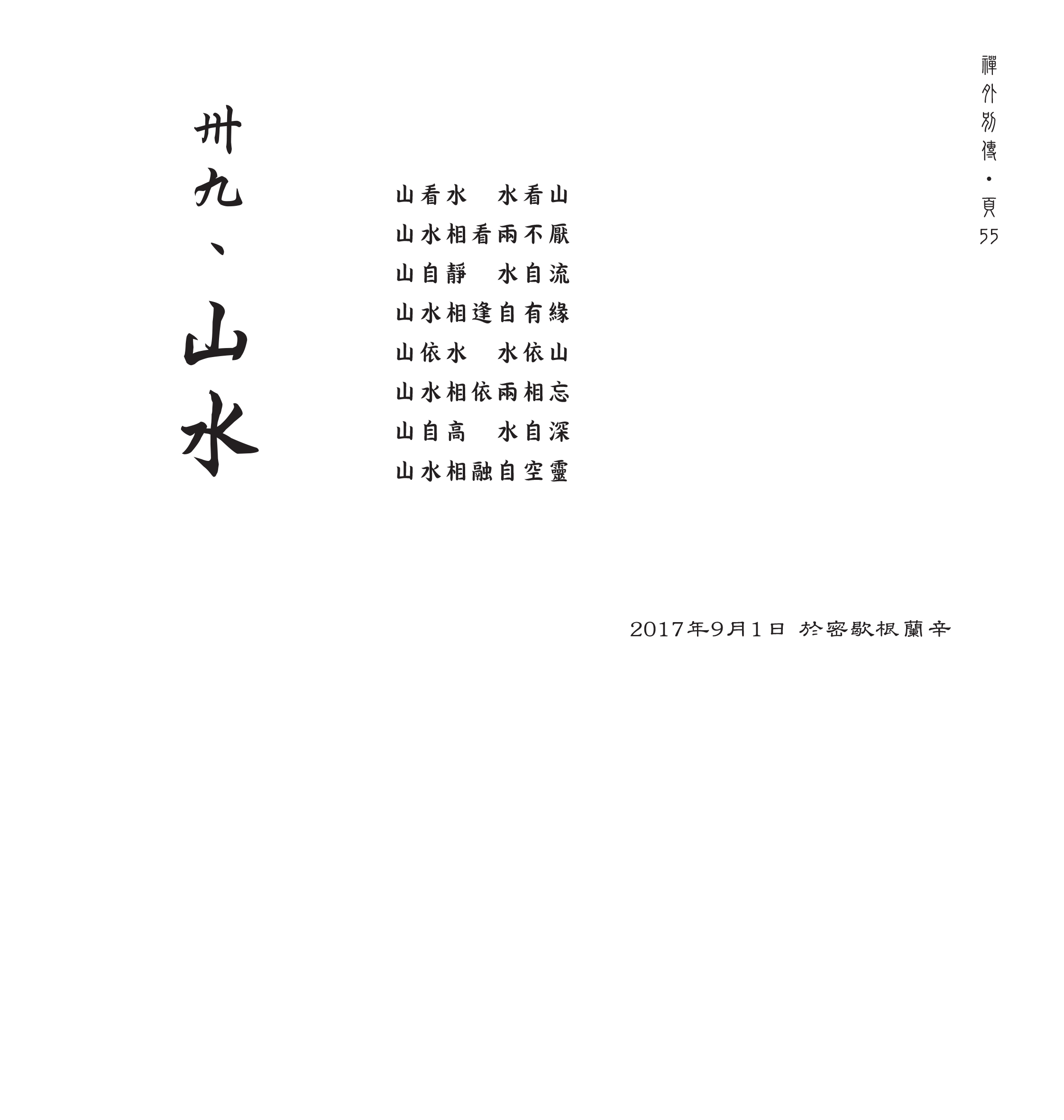
"Mountains and Waters"
This poetic verse sketches a Zen-infused landscape painting with minimalist language, yet within its lines, it reveals the profound wisdom of equality and non-duality.
The opening couplet, "Mountains gaze at waters, waters gaze at mountains," superficially depicts the interaction between mountains and waters, but metaphorically hints at the initial encounter between a practitioner and the external world. A Zen practitioner observes the environment without separating it from their own mind; the mutual gaze of mountains and waters signifies the beginning of the fusion of mind and matter. "Neither tires of the other" not only expresses the harmonious coexistence of mountains and waters in their natural state but also metaphorically suggests the practitioner's equanimity in viewing all things—neither grasping nor rejecting, neither clinging nor distancing—embodying the wisdom of living in the world.
The second couplet, "Mountains are naturally still, waters naturally flow," conveys the naturalness of Zen practice. The stillness of mountains and the flowing of waters resemble the Zen practitioner's attitude of integrating movement and stillness into one. Here, the character "自" (naturally) in "自靜" (naturally still) and "自流" (naturally flow) serves as the best annotation for naturalness. The natural state of mountains and waters is the manifestation of the Dao, free from artificiality. The encounter of "自有緣" (naturally meeting) also reflects the practitioner's deep insight into the law of cause and conditions.
The third couplet, "Mountains rely on waters, waters rely on mountains," with its state of mutual dependence, metaphorically hints at the Middle Way principle of the "non-dual Dharma gate" in Zen. The interdependence of mountains and waters is akin to the practitioner's shift from seeking externally to turning inward for self-realization. When the discriminating mind dissolves, the opposition between mountains and waters naturally vanishes, and the boundaries between self and other are broken, leading to the realization of the state of "兩相忘" (mutual forgetting).
The final couplet, "Mountains are naturally high, waters are naturally deep," elevates the imagery of mountains and waters to a poetic expression of the emptiness of Prajna. The towering height of mountains and the profound depth of waters point to the infinite vastness of ultimate emptiness. Here, the character "自" (naturally) in "自高" (naturally high) and "自深" (naturally deep) is a praise of the inherent virtues of one's nature. The state of "相融自空靈" (naturally blending into emptiness and spirituality) showcases the ultimate wisdom of the Zen practitioner transcending dualistic oppositions.
This poetic verse uses mountains and waters as metaphors, progressively revealing the spiritual journey from "not being deluded by external conditions" to "forgetting both self and object," and ultimately reaching the state of "emptiness and spirituality without hindrance." It resonates with the teachings of the *Platform Sutra of the Sixth Patriarch* on "no-thought, no-form, no-abiding," calling on people to return to their own minds and realize the Zen state of "mountains and waters naturally blending into emptiness and spirituality".
Between mountains and waters, Zen is everywhere; between movement and stillness, awareness is in every thought.
(Note: This content has been translated by AI. In case of any discrepancies, please refer to the original Chinese text as the authoritative source).